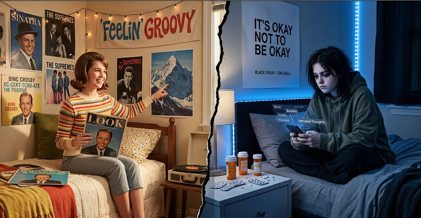
Look at the music charts today, and you will find a jarring landscape of existential dread. Where teenage anthems once boomed with horn sections and unshakeable optimism, today’s youth spend their time plugged into earbuds, nodding along to a soundtrack of clinical depression, panic attacks, and severe self-loathing.
Take a track like Tom Odell’s “Black Friday,” where he gasps for air, weeping, “I look in the mirror… I wanna better body, I want better skin.” Or look at pop sensation Olivia Rodrigo in “making the bed,” singing about her life being a nightmare where “the brakes go out on me.” From Natalie Jane’s “Intrusive Thoughts” to Kyle Hume’s “Fine,” today’s young artists treat music like a private therapy session. It seems every member of Generation Z has a diagnosed syndrome, an intrusive thought, or a prescription medication to sing about. They are a demographic entirely consumed by what is wrong with them.
The contrast with the past is staggering. In 1944, amidst the literal rubble of World War II, Bing Crosby and The Andrews Sisters didn’t Wall Street their worries; they instructed the youth to “ac-cent-tchu-ate the positive, elim-i-nate the negative.” Even as the world faced massive geopolitical tension, teens in the 1950s and 60s looked outward with resilience. Frank Sinatra’s “High Hopes” taught a generation to laugh at impossible odds, while Simon & Garfunkel’s “Feelin’ Groovy” celebrated the simple, unmedicated joy of slowing down and looking at the world. When those teens faced hardships, they danced it out to the communal, soaring energy of Marvin Gaye’s “Ain’t No Mountain High Enough.”
Yesterday’s youth used music to rise above reality; today’s youth use it to wallow in it. Fed by a steady diet of social media algorithms and a culture that rewards victimhood, modern teens have swapped resilience for a medical chart. Rather than fighting through the normal growing pains of adolescence, they label every bad day a psychological crisis. By romanticising their internal anguish in viral hits, today’s young people aren’t just reflecting their negativity—they are actively manufacturing a culture where being “okay” is completely out of style.